Wilful errors
An address given on the occasion of the opening of Conversations Between Word & Image, a group exhibition at Glen Carlou Gallery, 30 November 2025.
I spend a good deal of time interpreting artworks in text. The premise of this exhibition, and the workshop in which its dioramas and drawings were developed, follows the same impulse but goes the other way, from text to artwork. Invited to offer a few words here today, I wondered what mechanisms might apply to acts of translation in either direction, and arrived at a fragmentary understanding that extends from my own conflicted feelings about what it is, exactly, that I do as an art writer.
In my vocation, I am all too familiar with the frustrations of language. Words illuminate and limit, they define and they undermine. That language cannot contain the whole, I take as given. Any text on an artwork must first abandon the ambition of a literal equivalence. I concede to this fact before beginning – but still persist with grim determination in trying to convey something essential to the work. Trying has its merits.
The ancient Greeks termed the vivid description of artworks in writing ekphrasis – from the root verb ‘to point out’. Look, the parent instructs the child. We follow the finger to the subject. We are initiated into the habit of noticing. Words likewise point. Like fingers, they are dextrous, jointed – and here I am reminded of a verse from the philosopher Heraclitus:
Joints: whole and not whole,
connected-separate, consonant-dissonant.
Those last two antonym pairings are themselves jointed with hyphens: connected-separate, consonant-dissonant. Another line comes to mind, this from poet and Greek classicist Anne Carson, who describes adjectives as ‘the latches of being’:
attaching everything in the world to its place in particularity.
Joints, latches, fingers, things that hinge, that hold two parts in relation. These are necessary in wresting that essence into writing.
Like is another latch – the simile – as is any other figure of speech: metaphors, metonyms. Those hyphens, too; semi-colons. Conjunctions of every order. Joints all.
Translation between languages is an exercise in concession. Transposition between mediums even more so. The first form and the second form might bear a passing symmetry, but the last will always be revealing of an interceding voice; I shifts into we, the soloist is made to sing ensemble – the writer muscles in on the artist’s melody. I impose my cadence on the other’s.
Such transposition makes for poor mimesis – another Greek word, this one denoting mimicry. The end result will be imprecise, weighted with manifold failures. Imitation is, as Carson writes:
Aristotle’s collective term for the true mistakes of poetry.
What I like about this term
is the ease with which it accepts
that what we are engaged in when we do poetry is error,
the wilful creation of error,
the deliberate break and complication of mistakes
out of which may arise
unexpectedness.
We might say the same of art writing, that other genre of productive defeat. The adjective is incorrectly applied, the latch that will not fit. But something happens in trying to hinge two things together. The exercise is one of approximation, not perfection. A sense, not a semblance. Accuracy, as it transpires, is not applicable to art of any form – it belongs to mathematics and measurements.
But then, I do not attempt to restage the artwork in writing. I am not interested in ekphrasis, however much I like pointing. In many instances, I may describe the work’s material and compositional attributes only briefly. But I want you to pay attention to what I think is curious or compelling or contradictory about the work. I want you to find it interesting because I find it interesting. Look again.
I remind myself to proceed from stillness. To pause before I point. In translation practice, as my friend Donovan Greeff writes, ‘this is called reception: allowing the text to settle over you before prising it apart.’
One might use this suspended moment of reception to consider the following:
How closely will you hew to the spirit of the first form? Will you defer to style or content? In what divergences will you indulge? The issue at hand, fundamentally, is not truth but interpretation. Gloss and glean, take liberties.
Degrees of detail are another necessary consideration. Will you describe in broad gestures, or pursue instead a complexity of subtleties, down the forking veins towards the smallest of capillaries at the very end of the finger that points? Will you invite the other to look, or will you say, no bother looking, I will tell you all about it?
In writing about art, silence is instructive. Resist overdetermining the first form; do not describe the whole. Abridge, leave space, redact if you must. Such silence belongs as much to a personal ethics – a conviction that one must never hold too tightly – as it does to aesthetics.
Aesthetics is another lovely word of Greek origin. Its root does not apply so much to beauty as common usage would have you think, as to the singular appearance of things, the perception of the particular. And what was it Carson said of adjectives? Those latches of being… attaching everything in the world to its place in particularity.
Incidentally, the word translation is not Greek. It comes from the Latin: to carry across. It has an oily sound to it, and the activity it describes is similarly slippery. The essential thing to be carried by translation is mercurial meaning; you have only your cupped hands. You will spill, but it is raining, so anything lost is easily replaced. You might also cry a little at the effort – add these tears to the substance, too. The essential thing carried changes, but not entirely; your hands, held out in offering, retain something of its slick wetness.
Here, in this exhibition, a pivot (which is itself a hinge of a kind) – rather than the writer transposing the artwork, the artists transpose the text. In relay, the artists carry across some impression from a text to an object and then to an image. The material flatness of writing is given dimension as a diorama and then compressed again into drawing. Something is lost and something is gained at each crossing – remember those cupped hands.
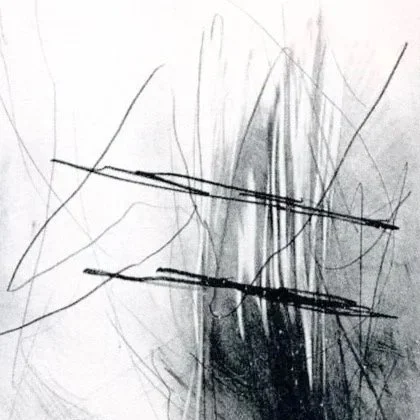
There is no etymology of charcoal lines. They do not carry history as words do; every line is the first line. But they do possess a grammar, rhythm, pacing, inflexion points, and like sentences, they are linear. A drawing, though composed of such lines, is not read as text is read. An image is seldom episodic, though it can be arranged in sequence with others; it is seldom narrative, though it might convey drama, character, and feeling. Images address us with immediacy; reading is durational. And perhaps it is these different timescales of revelation that make any translation between the two at once so futile and so fertile.
The artwork cannot imitate the text; the text cannot trace the artwork. But they can try, and in trying, afford all sorts of reflections about fidelity and felicity – about what it is to remain faithful to both your subjective experience of the subject and the subject itself.
If poetry is the
wilful creation of error,
the deliberate break and complication of mistakes
out of which may arise
unexpectedness.
Perhaps translation is the trying otherwise, but gainfully failing just the same.